

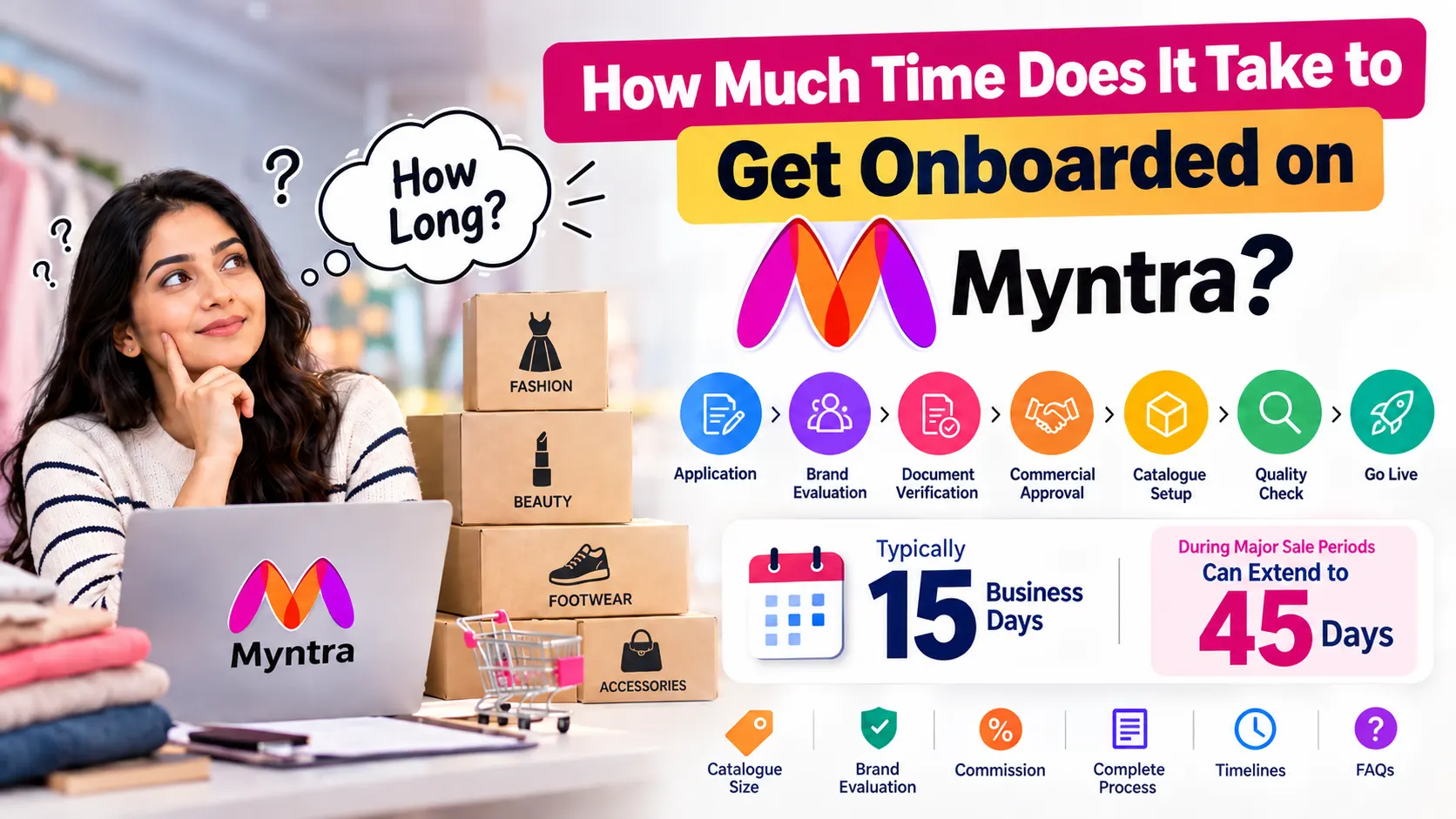
If you are a fashion, beauty, footwear or lifestyle brand planning to sell on Myntra, one of the first questions you are likely to ask is:
“How much time does it take to get onboarded on Myntra?”
The answer is not the same for every seller.
Myntra is a curated, brand-focused marketplace. Unlike marketplaces where a seller can register and start listing products relatively quickly, Myntra evaluates the brand, category fit, catalogue quality, product presentation, documentation and commercial viability before allowing a seller to go live.
According to Myntra’s current partner portal, a brand that meets its selection criteria can be onboarded in around 15 business days. However, Myntra also states that the timeline can extend to up to 45 days during major sale events.
In practice, the total time from preparing your application to having a properly launched catalogue can be longer if documents, product information, images, commercials or catalogue requirements are not ready.
In this guide, we explain the complete Myntra onboarding process and what sellers should prepare before applying.
Myntra Seller Onboarding: How Long Does It Really Take?
A simple way to understand the process is:
Application → Brand Evaluation → Documentation → Commercial Approval → Catalogue Setup → Quality Check → Go Live
For a well-prepared brand, the process can move quickly. Delays generally happen when the brand is not ready with the required documents, catalogue information, product images, pricing or operational setup.
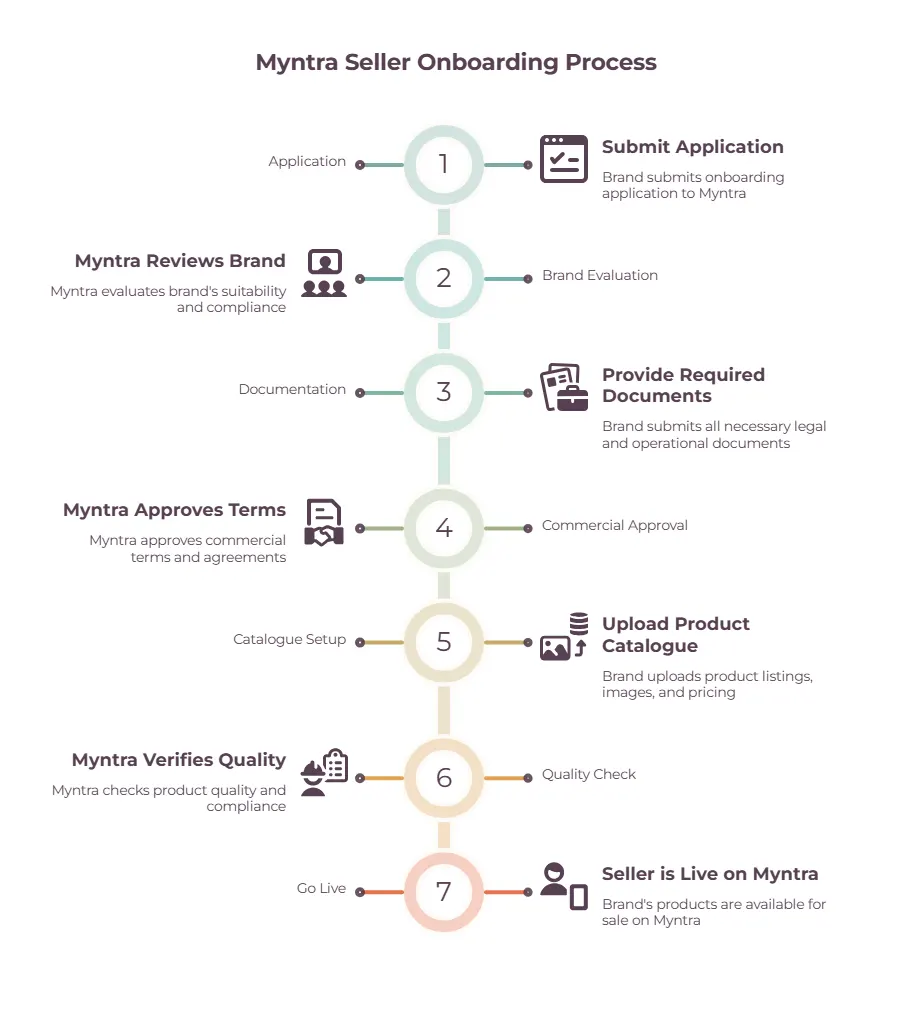
Indicative Myntra onboarding timeline
| Stage | Approximate Time |
|---|---|
| Registration & application | 1–2 days |
| Brand/category evaluation | Variable |
| Document verification | 1–5 business days |
| Commercial discussion | Variable |
| Agreement & technical setup | Few days |
| Catalogue preparation | 2–7 days |
| Catalogue/QC process | Variable |
| Final go-live | After approval |
| Myntra-stated onboarding benchmark | Around 15 business days |
| During major sale periods | Can extend up to 45 days |
These are not guaranteed timelines. Myntra’s selection process depends on the brand and its readiness.
Why Does Myntra Take Time to Approve a Brand?
The biggest difference between Myntra and many other marketplaces is that Myntra evaluates the brand, not simply the seller account.
The platform wants to understand:
- What type of brand are you?
- Which category do you operate in?
- Is your product range relevant to Myntra’s customers?
- Is your catalogue large and diverse enough?
- Are your products competitively priced?
- Is the brand professionally presented?
- Do you have proper brand ownership or authorization?
- Can you maintain inventory and fulfil orders reliably?
- Are your product images and information marketplace-ready?
Therefore, submitting GST and PAN details alone does not guarantee approval.
What Catalogue Size Do You Need for Myntra?
This is one of the most common questions from new sellers.
Myntra does not publicly specify one universal minimum SKU count applicable to every brand and category.
Instead, catalogue depth and quality are considered as part of the brand evaluation.
For example, a brand selling women’s ethnic wear may have a very different catalogue requirement from a skincare, footwear or accessories brand.
Instead of asking only:
“How many products do I have?”
ask:
“Does my catalogue look like a serious brand collection?”
A stronger Myntra application generally has:
- Multiple styles
- Multiple sizes
- Multiple colours/variants where relevant
- A clear category assortment
- Consistent product photography
- Proper size charts
- Complete product attributes
- Competitive price positioning
- Sufficient inventory
Example
Suppose you have a fashion brand with only 5 products and 8 total SKUs.
Even if the products are good, the catalogue may not demonstrate sufficient assortment.
On the other hand, a brand with 30–50 strong styles and multiple size/colour combinations can present a much more convincing range.
There is no magic number that guarantees approval. Catalogue relevance and quality matter along with catalogue width.
Myntra Brand Evaluation: What Does Myntra Check?
Brand evaluation is one of the most important stages.
Myntra’s current partner information states that a brand should have a sizeable catalogue, quality products and a unique value proposition to qualify for onboarding.
The evaluation can include several factors.
1. Brand Identity
Your brand should have a clear identity.
Prepare:
- Brand logo
- Brand name
- Brand story
- Website/social presence where applicable
- Packaging
- Product positioning
- Target customer
- Category positioning
A professionally presented brand generally creates a stronger first impression.
2. Product Quality
Your products should meet the expected quality level for your category.
For fashion brands, this can include:
- Fabric quality
- Stitching
- Finishing
- Fit
- Colour accuracy
- Size consistency
For beauty brands, product formulation, packaging, labelling and compliance become especially important.
3. Catalogue Depth
Myntra wants to see whether your brand has enough assortment to offer customers meaningful choice.
4. Price Positioning
Your MRP and selling-price strategy should make sense for the category.
You should calculate your margins before agreeing to marketplace commercials.
5. Product Presentation
Your images, titles, descriptions, attributes and size information should be professionally prepared.
6. Category Fit
Myntra is primarily focused on fashion, beauty, footwear and lifestyle categories.
Your products need to fit the marketplace’s customer base and category strategy.
What Documents Are Required for Myntra Seller Onboarding?
Keep your documents ready before starting the application.
Common requirements can include:
Business Documents
- GST certificate
- PAN
- Business/entity details
- Bank account information
- Cancelled cheque or bank proof
- Registered business details, where applicable
Brand Documents
Depending on your situation:
- Trademark certificate
- Trademark application details
- Brand ownership proof
- Brand authorization letter/NOC if you are selling another company’s brand
Product & Catalogue Information
You should also prepare:
- Product catalogue
- SKU information
- Product images
- Product attributes
- Size charts
- MRP
- Selling price
- Inventory
- Product descriptions
The exact requirements can vary depending on the seller, category and Myntra’s onboarding process.
How Does the Myntra Seller Onboarding Process Work?
Step 1: Register on the Myntra Partner Portal
The first step is to register through Myntra’s official partner platform.
Myntra’s partner portal describes the onboarding journey through registration, selling readiness and earning/settlement processes.
Step 2: Submit Business Details
You provide your business and brand information.
Make sure the information matches across your GST, PAN, bank and brand documents.
Even small inconsistencies can create verification delays.
Step 3: Brand Evaluation
Myntra evaluates whether your brand fits its selection criteria.
This is where brand positioning, category, catalogue, product quality and value proposition become important.
Step 4: Commercial Discussion
Once the brand is considered suitable, commercial terms are discussed.
This is an important stage because your profitability depends on the final commercial structure.
Step 5: Agreement & Technical Setup
After commercials are finalized, the required agreement and technical onboarding process can begin.
Step 6: Catalogue Creation
Your product data is prepared according to Myntra’s catalogue requirements.
Myntra specifically highlights the importance of accurate:
- Brand tag information
- Product sizing
- Article images
- Product information
for catalogue creation.
Step 7: Quality Check
The catalogue and product information need to meet the applicable marketplace standards.
Incorrect attributes, poor images, wrong sizing or incomplete information can create delays.
Step 8: Inventory & Operations Setup
Before going live, sellers need to be operationally ready.
This includes:
- Inventory
- Packaging
- Order processing
- Dispatch
- Returns
- System/OMS integration where applicable
Myntra provides its own OMS for order and inventory management.
Step 9: Go Live
Once all required processes are completed, your products can become live on Myntra.
What Is Myntra’s Commission?
This is another area where sellers often receive confusing information online.
There is no single publicly applicable Myntra commission rate for every seller.
Myntra’s commercial terms can vary depending on factors such as:
- Category
- Product type
- Brand
- Selling model
- Commercial agreement
- Promotional arrangements
- Other marketplace terms
Therefore, sellers should not assume that a commission percentage published on a third-party website will be their actual Myntra commission.
Your final commercial agreement is the number that matters.
Some third-party websites publish indicative rates ranging widely by category, but these should be treated as estimates rather than official Myntra rate cards.
Don’t calculate profitability using commission alone
Your Myntra profitability calculation should consider:
Selling Price – Product Cost – Marketplace Commission – Fixed/Other Charges – Logistics/Fulfilment – Returns – Discounts/Promotions – Advertising = Approximate Contribution
This is especially important in fashion, where returns and discounting can significantly affect profitability.
Does Myntra Charge an Onboarding Fee?
Do not assume that every amount quoted by an agency is an official Myntra onboarding fee.
Third-party agencies may charge sellers separately for services such as:
- Seller registration assistance
- Catalogue creation
- Image editing
- Product listing
- Marketplace management
- Account management
- Advertising
- Catalogue optimization
These are different from Myntra’s own commercial terms.
Always ask:
“Is this an official Myntra charge or an agency/service fee?”
How Can You Reduce Myntra Onboarding Time?
If you want to get onboarded faster, prepare everything before submitting your application.
1. Keep documents ready
Don’t start searching for your trademark, GST or bank documents after applying.
2. Prepare your catalogue
Have your SKU master ready.
Include:
- SKU code
- Product name
- Brand
- Category
- Colour
- Size
- Fabric/material
- MRP
- Selling price
- Inventory
- Product description
- Size chart
3. Get professional product images
Your catalogue is extremely important.
Use consistent photography and make sure your products are clearly visible.
4. Check your margins
Know your minimum profitable selling price before discussing commercials.
5. Keep inventory ready
Getting approved but having insufficient stock can waste the opportunity.
6. Avoid document mismatches
Make sure your legal/business information is consistent.
7. Don’t apply during a critical sales period without preparation
Myntra itself indicates that onboarding timelines can extend during major sale events, potentially reaching up to 45 days.
What Can Delay Myntra Onboarding?
Some common causes include:
- Incomplete documentation
- Trademark/authorization issues
- Brand-category mismatch
- Weak catalogue
- Poor product photography
- Incomplete product attributes
- Incorrect size charts
- Pricing problems
- Commercial discussions taking longer
- Technical integration delays
- Catalogue QC issues
- Major sale periods
- Operational readiness problems
The good news is that many of these delays can be prevented before the application is submitted.
How Much Time Should a New Seller Actually Plan For?
If you are a new brand, don’t build your business plan around the assumption that you will definitely be live in 15 days.
A safer approach is:
Prepare for 3–6 weeks, while keeping additional buffer for catalogue, commercial, technical or sale-period delays.
Myntra’s official current benchmark is around 15 business days for qualifying brands, but its own portal says major sale periods can extend onboarding to up to 45 days.
The better prepared your brand is, the fewer avoidable delays you are likely to face.
Myntra Onboarding Checklist for Sellers
Before applying, ask yourself:
Brand
☐ Is my brand properly positioned?
☐ Do I have trademark/brand authorization documents?
☐ Is my category relevant to Myntra?
Catalogue
☐ Do I have sufficient styles?
☐ Are my sizes and variants ready?
☐ Are product images professional?
☐ Are size charts available?
☐ Are all product attributes complete?
Commercials
☐ Do I know my product cost?
☐ Have I calculated my minimum selling price?
☐ Have I considered commission and other marketplace costs?
☐ Have I considered returns and discounts?
Operations
☐ Is inventory ready?
☐ Is packaging ready?
☐ Can I process orders on time?
☐ Is my team ready for marketplace operations?
If you can answer yes to most of these questions, your brand is in a much stronger position to approach Myntra.
Final Thoughts
Getting onboarded on Myntra is not simply about registering as a seller.
It is about convincing Myntra that your brand, products, catalogue, pricing and operations are ready for its marketplace.
For a qualifying brand, Myntra currently states that onboarding can happen in approximately 15 business days, while major sale periods can extend the process to up to 45 days.
However, the real advantage comes from preparation.
A seller who submits incomplete documents, poor images and an unstructured catalogue may spend weeks fixing problems.
A seller who approaches Myntra with a ready catalogue, professional product presentation, correct documentation, clear brand positioning, proper margins and operational readiness can make the onboarding process considerably smoother.
If you are planning to launch on Myntra, don’t just ask:
“How quickly can I get approved?”
Ask:
“Is my brand Myntra-ready?”
That is the question that can make the biggest difference.
Frequently Asked Questions
1. How long does Myntra seller onboarding take?
Myntra currently states that qualifying brands can be onboarded in around 15 business days. During major sale periods, the process can extend to up to 45 days.
2. What is the minimum catalogue size for Myntra?
Myntra does not publicly specify one universal minimum SKU count for every category. Catalogue width, quality, category relevance and brand positioning are considered during evaluation.
3. Is a trademark required to sell on Myntra?
Brand ownership or authorization documentation is generally important for brand verification. If you are not the brand owner, appropriate authorization may be required.
4. What is Myntra’s commission rate?
There is no single public commission rate applicable to every seller. Commercial terms can vary by seller, category and agreement. Always confirm your actual commercial terms with Myntra.
5. Can a new brand sell on Myntra?
Yes. New brands can apply, but they need to demonstrate suitable brand positioning, products, catalogue quality and marketplace readiness.
6. Can I sell multiple brands on Myntra?
This depends on the brand authorization and onboarding structure. If you are not the owner of a brand, keep valid authorization/NOC documentation ready.
7. What happens after brand approval?
After approval, the seller generally moves through commercial finalization, agreement/technical setup, catalogue creation, quality checks, operational readiness and finally go-live.
8. Can an agency help with Myntra onboarding?
Yes. An experienced marketplace agency can assist with documentation preparation, catalogue creation, product content, images, onboarding coordination and marketplace operations. However, the final approval remains subject to Myntra’s own process.
Need Help Getting Your Brand on Myntra?
At eComAdvisor, we help brands prepare for marketplace onboarding and growth—from catalogue preparation and product listings to marketplace strategy and ongoing optimization.
If you are planning to launch your brand on Myntra and want to understand:
“Is my brand ready for Myntra, what catalogue should I prepare, and how should I calculate my margins?”
Talk to the eComAdvisor team. 📞 8368378787




Leave A Comment